

A wealth of letters in German, Yiddish, Polish and Hebrew: How a Galician Jewish family got their letters past the censor and to New York during World War One

Updated: May 14
It just so happened that at the time of COVID-19, when some people were baking sourdough bread or becoming nomads, I spent weeks upon weeks translating old, handwritten German letters. In March of 2021, we were a year into the pandemic and still hadn’t gotten vaccinated. The homebound life dragged on. But I heard from a new client who brought new interest to my limited slate of activities and made me feel useful and connected. Her voice on the phone was enthusiastic, personable, and determined to explore her family history.
Joyce Bloom, in New York, sent me her great-grandparents’ letters from Austria-Hungary to her grandfather, Isaac Holreich, between 1914 and 1921, who at the time of World War I was already living in Brooklyn, NY. I spent months engrossed in this correspondence, hermited away in the office of my third-floor apartment, and I started to worry about the writers. Would Isaac’s brother Abraham come home from the war? Would Isaak visit his family back home in Galicia ever again?
Joyce herself wasn’t sure of the answers to these questions until she received the translations. She had little knowledge of most of her grandfather’s family until she read their letters. In fact, much still remains a mystery. The letters stop after the 1920s, and research into this Jewish family’s fate is ongoing.
A collaboration by German, Yiddish, and Hebrew translators
There were hundreds of letters, some in German, some in Yiddish, some in Polish, often with a smattering of Hebrew. (Accordingly, the family’s last name could be spelled Hellreich, Hollreich or Holreich, as this was a transliteration.) Many letters were filled with five different people’s handwriting, crammed into spaces at the bottom of the page, climbing up the side margins, upside down at the top. There was Latin script, there was the old German script (Kurrentschrift), there was unique spelling.

The letters I was to translate looked German, not Yiddish or Polish, on first glance. However, I was quickly confronted with words and phrases that didn’t make sense to me, especially on the postcards from Isaak’s father, Elias. An example: nor wen noch viel gedren wet so werde ich brauchen geld von dir zu bekomen weil von Toki ist nicht meiglich.
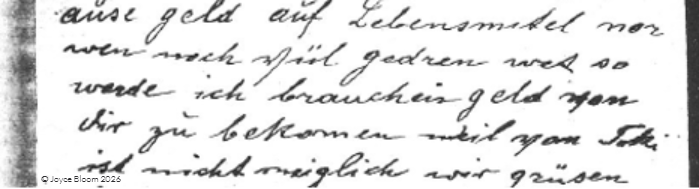
What did “gedren” mean? And “wet”? An email exchange with two other German-to-English translators was inconclusive; Ken thought “wet” could be “wird,” which turned out to be the case. Sigrid thought “gedren” could mean “gedrängt.” But we weren’t sure.
Dr. Nina Warnke was the lifeline who allowed us to fully understand the letters. A PhD in Yiddish Studies who taught Yiddish at the YIVO Institute for Jewish Research, Nina was able to shed light on what we were looking at (along with Yankl Salant, who assisted on some letters, as well).
What did “nor wen noch viel gedren wet” mean? Nina explained:
![A comment that Nina had made on one letter: "I read it differently from your friend: "nor [=but] wen noch viel gedren wet" might be "gedoyrn" = dauern. "But if it will last/take much longer, then I will need to get money from you." I believe "it" refers to the general situation or not being able to register a place of residence.](https://static.wixstatic.com/media/8bbf2b_c2515d9e050a42b593216bc3a3e4e26c~mv2.png/v1/fill/w_633,h_225,al_c,q_85,enc_avif,quality_auto/8bbf2b_c2515d9e050a42b593216bc3a3e4e26c~mv2.png)
Comments like these, and Zoom calls in which Nina explained what such sentences seemed to mean from a Yiddish perspective, were essential to the project.
Linguistic diversity within the family
Why would Yiddish speakers write in German? In order to get their letters past the censor more quickly during World War I. The censorship offices had more capacity to process the German letters and less capacity for the Hebrew script in which Yiddish is written.
Nina was tasked with the Yiddish part of the correspondence, which included letters from both parents and a brother. She, too, was confronted with a linguistic complexity that required yet another consultant. The letters from parents and brother were steeped in traditional piety, evident from their frequent use of traditional Hebrew phrases.
As native speakers of Yiddish, the Holreich family’s German language abilities varied. Sons Abraham and Josef probably attended yeshiva, while the daughters (Amalie, pronounced “Amalia,” Ida, Pepi, and Frimma) had private tutors at home—explaining why their German was stronger than their brothers’. Isaak’s sisters’ German was the most schooled and could be considered real German. His father was able to write in the Latin alphabet, but he used a style that was a Yiddish-inflected form of German, expressing himself with much less mastery than he showed in his Yiddish letters. These were the letters of someone who was writing in German as best he could. Isaak’s mother, Hinda, could not write in the Latin alphabet at all and did not write any German letters.
When I encountered Hebrew phrases, I turned to a friend I was lucky to have: Iddo Haklai, a PhD in Near Eastern and Judaic Studies. Sometimes, the phrases were challenging even for him. “Wajomer daj lecurujoseme,” he wrote me, “seems to be a phrase in the Ashkenazic pronunciation of Hebrew, written with Polish spelling.” May (God) declare an ending to their troubles was one translation. “In Ashkenazi pronunciation of Hebrew, Letzarotam is pronounced Letzuresem, and since C in Polish is pronounced as TZ, and J is pronounced as Y, it makes sense that what he is writing is vayomer dai letzuresem (vayomer day letzureysem),” Iddo explained.
Sending multiple copies in hopes they would get through
Joyce shared with me dozens of letters that her grandfather Isaac had saved, but we don’t have his responses. “I’m sure he wrote to his family,” Joyce told me. “Knowing him, he probably wrote to them every week. And he was always sending them money.”
Yet, this was a refrain in Isaac’s family’s letters:
“We have not received any word from you in nearly four months.”
“We really do not know what to think.”
“We are hoping for a letter from you. It has been a very long time since we last received one.”
Many letters must have gotten lost or delayed in the chaos of World War I. His father sent important letters several times to make sure at least one of them made it to his son. It was so hard for mail to get to its destination during the war that Isaak’s family would send mail to Isaak in New York to send on to his brother Josef in Zbaraz (present-day Ukraine). It was apparently easier to send it across the Atlantic and back than to mail it directly.
In one letter from April 17, 1916, Elias has decided that a mysterious remittance of money must have come from an Uncle Bumi. “Why doesn’t he write to me? Does money seem cheaper to him than a letter?”

When the censorship office in Brno sent a letter back, now requiring that all letters be written in German, not Yiddish, so that the censors could better read them, it was a great frustration for Isak’s mother.
Elias writes on 20 January 1916, “Your dear mother wrote you a letter and a card last week. They were returned to us yesterday with a note that they did not accept letters in Yiddish characters, so we ask you to write in German only.” He tells Isaak in another letter, “Your dear mother sends her extra special greetings. She cannot write to you, but I am her representative.” And, “She feels sad because her writing is interrupted and she can’t write you in her own hand.” A stamp visible on some envelopes: “EXAMINED, MILITARY CENSOR.”
The ravages of World War One
After the outbreak of war in 1914, a time when many villages in the region were destroyed, the family fled Russian forces and headed west from the small town of Toki in the Ternopil Oblast region of Galicia, present-day Ukraine. By August 31, 1914, they had made it westward to the city of Stryi, in Lviv Oblast. By April 26, 1915, the family was writing to Isaak from Brno (Brünn in German), about 900 kilometers west of Toki, now part of the Czech Republic but at that time falling within Austria-Hungary.
Isaak was living with his uncle Chaskel in Brooklyn, far away from his parents and siblings. One brother was serving in the Austro-Hungarian forces, another still lived east of Toki, and his parents and four sisters settled in Brno for the remainder of the war.
On October 12, 1915, Elias tells his son Isaak of their struggles as refugees: They can’t go home because home is too close to the city of Tarnopol, and the authorities recognize the family’s identification only when they feel like it.
Elias writes, “There were 2,000 refugees here. By this point, 1400 were expelled from West Galicia and from the East and have stayed here.”
In January 1916, Isaac receives a grim letter from a cousin, Esther, that she wants him to share with their aunt and uncle. Esther spent 14 months “with the cursed Russians” and then fled to the city of Kolomyia (Ukraine). At the time of writing she has not heard from her parents in two years. She wanted to contact relatives sooner but didn’t have their addresses, everyone having been displaced. Now she has fled for a second time, leaving everything behind and walking for 8 days—pregnant—until she reaches Brno, where she promptly gives birth the following day.
She writes, “I have received no word from my parents. I have no idea where my husband is. I have been robbed of all of my property and possessions. And so I am now in Brno, weak, with a small infant, without any resources!”
We don’t know what Isaak may have replied to Esther, but we do know that these were the grim realities that the Holreichs were living with as they wrote to Isaak.
Inflation
Before the war, the Holreichs had been a thriving, affluent family, but World War I became a time of hardship and inflation. In Brno, the sisters find work as seamstresses, but work is slow and inflation rapid. The family relies on Isaak’s remittances, all the while missing one another, missing their son in New York, and missing their son Abraham, who was serving in the Austro-Hungarian military.
A letter from Amalie, March 5, 1916:

Dear Brother Isi,
[…] What I wish for you, my dear Isi, is that you may have nothing but a great deal of happiness, joy and enjoyment throughout your whole life. In a word: A glorious life. […]
With the money that you sent us we went right out and bought shoes for Frimi, which cost 24 Kronen. That is the cheapest price. You’ll think that maybe that means they are really nice shoes. They are exactly the same kind of shoes that she always wore at home for around 7 Kronen. And that is what it is like. Everything here is three times as expensive as it was.
In another 1916 letter, Amalie writes, “The inflation here is very high. Every penny goes to groceries, which consist mainly of dry bread.”
Sister Pepi writes, on September 15, 1916,
Dear Isi!
In this letter, I want to tell you a little bit about our situation. Brno is a beautiful city, but despite all of the city’s charms, it doesn’t interest us. Oh, how we long for our home. We ourselves did not even appreciate how happy we were in sweet little Toki. Only now do I realize how rich and happy we were. May the Lord grant that everything may simply come to an end.
What would become of this loving family?
As I read the letters, I grew more and more concerned about two questions: Would Isaak’s brother Abraham survive his World War I military service and go home to his sisters and parents? And, would Isaak ever see his family again?
There were many postcards from Abraham, who was serving in the armed forces. As the weeks went by, I worried more and more about what might happen to him. Eventually, I reached a letter from Elias, August 18, 1917, reporting that Abraham was missing and could be in Italian captivity. Did he make it? We don’t know.
Joyce shared with me a picture of the family that must have been taken sometime during World War I or not long after—into which a young Isaak has been airbrushed.

But would he ever see them again, or would he continue to be airbrushed into their family photos? And what about everyone else—Elias? Hinda? Amalia? Ida? Frimma? The last German letter that I translated was written to Isaak from Toki, May 20, 1921, but Joyce knows they lived beyond this date. Death details are not confirmed, but Joyce’s research is ongoing.
Izaak’s sister (Joyce’s great-aunt) Pepi moved first to Israel, then to New York, where Joyce knew her growing up.
The next war and pogroms
Later on, by 1920, World War I has ended and the family is back in their home region, in Tarnopol. But the region is in chaos during attempts to establish an independent state in repeated military conflicts. Even Isaak’s older brother Josef is forced to write to him in desperation and ask for financial help. Isaak continues to send money to his whole family, some in the form of cash—which is sometimes stolen from the envelopes.
Safety was just as much of a concern as money. Amalie, likely referring to the Soviet-Polish War that raged in the area and the significant anti-Jewish violence that accompanied it, writes in December 1920:
“There have been many times of great unrest when we were prepared to leave here, but in times like those it comes down to whether to leave nearly everything behind and walk away with nothing but our lives and then there is still one question: Where to?”
Amalie asks Isaak to prepare all papers necessary to immigrate to America, wrestling with her parents’ reluctance to leave.
The present day
I had the pleasure of meeting Joyce and her sister, Hindy, in person in August 2021, at a café in New York. She assured me that her grandfather did see his family one more time, in 1931, when he went back to visit them. There is a photograph of him with his mother, Hinda.
And Joyce had the joy of being close with her grandfather, Isaak. “I saw him all the time,” she told me. “He was my favorite person on the planet. He was quite special. My grandma was, too.”
Isaak regaled his granddaughter with tales of his childhood growing up on the family farm, where they had horses, played in the barn, and enjoyed a nice standard of living. But he didn’t speak to Joyce about the World War I years, his siblings’ adult lives, or how they perished. “Maybe it was too painful for him, or maybe he missed the contact he had previously had,” she said.
Isaak lived a long and full life, passing at nearly 101 years of age in 1994. He had come to the US at age 19, around 1913. Isaak spoke Yiddish, Hebrew, Russian, Polish, English, probably a total of seven languages. He never spoke about his family using their German names, only their Yiddish ones.
One a summer morning, a year after completing my translations, I found an email from Joyce in my inbox that she had written from a bus ride, on a trip to Jewish sites in Europe.
On Weds., Jul 6, 2022, at 5:39 AM US Eastern time (11:39 AM in Europe), she emailed:
Dear Abby and Nina,
I hope you are well. I am on a bus going from Prague to Vienna. Have just passed a town called Brno and am wondering if it is the same as Brunn where my family was for so long. Do you know? Be well.
Best regards,
Joyce
It was the same town—and it seemed amazing to me that one hundred years had passed. Reading the letters made the Holreichs seem very real to me, as though they could almost still be over there somewhere in Ukraine. And now Joyce was passing by Brno, Czech Republic, on a bus, making their world seem even more immediate.
To think that Isaak’s granddaughter Joyce could send us a quick email from a bus while passing a town in which her ancestors were displaced for years, longing to go home, doggedly and devotedly penning letters in multiple languages (of varying degrees of foreignness) to communicate their hopes, plans, needs, well-wishes and news during wartime. It is a satisfying feeling to know that Joyce can now read faithful English renderings of her family's letters. I wonder if the writers would have been interested to contemplate the translation challenge we faced a century later.
